“All happy families resemble one another, each unhappy family is unhappy in its own way.”
With these captivating words, the supreme Russian artist, Leo Tolstoy, opens his magnificent masterpiece, Anna Karenina, and grips at my heart from that first paragraph until the closing words, 963 pages later. It is impossible to express everything I felt and experienced and learned from inhaling every word of Anna Karenina and yet I remain pertinacious to attempt so, a month after its completion. During this time, I have tossed one book after another aside, not because I found them to be in poor taste, only because it has been impossible to reap pleasure from lesser purity, lesser prose, lesser richness, anything lesser than Anna K. Reading Tolstoy is falling in love – with reading, with words, with characters, with thoughts, with dialogues, and with Anna and Tolstoy both – and finishing Anna K is that first love’s broken heart, never again will a novel touch me this profoundly, move me this deeply, and ache me so much. At least, I am sorely convinced as such today.
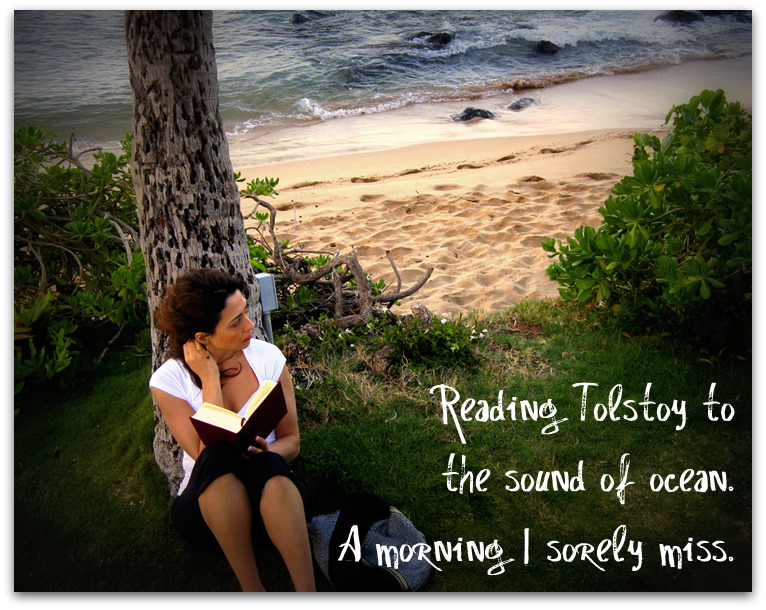
In November of 2008, I randomly picked up Irina Reyn’s “What Happened to Anna K?”, a modern take on Tolstoy’s original creation in print. An anomaly of choice for me as I am not one for either sequels or adaptations of books into another author’s versions. Can we not let the original remain the end-all and be-all for that literary work? But Reyn’s authentic Anna K. was an obsessive read for me. The author is extremely gifted and she will always be the one to have first introduced me to Anna, even if portrayed as a modern day 21st century Russian-American living in NYC! A month or so later, I picked up my hardcover Anna Karenina (Maude translation from Every Man’s library) but that was over a year ago. The book settled down on my shelf where I kept staring at it with intimidation. One day I am going to read it, I would say. Doubt befriended procrastination and a year of waiting went by. Now, I regret empowering either of those evils in my mind; reading Tolstoy is for anyone and everyone and the pleasure is immense for one spectrum of readers to another. In February, an angel of a friend promised to keep me company as we set out to read and finish Anna K together. Perhaps the only other thing that can add sweetness to reading Anna K. is to share the journey with a friend. In this post, I beg forgiveness for length as I pay tribute and gratitude to the world that Tolstoy weaved for us in his genius art.
Disclaimer: See Wikipedia entry for an excellent summary of the plot; I will not cover the plot in detail as that is not my point of this post. All of the writing here are based on my opinions and observations unless I state otherwise. I did not consult Wikipedia or other Tolstoy sources online. I organized my review as such for us:
Tolstoy on Writing Style:
The use of cohesive, comprehensive and exquisite prose:
No word feels redundant. No passage seems irrelevant. No character is without a purpose in the dozens upon dozens introduced. Not a word or paragraph would I wish to eliminate even among topics I found challenging to read. The best surprise of all on reading Anna K. was the ease of reading Tolstoy. I had prepared for a highly complex Russian novel; instead I found one to be of great depth, scale and detail and yet not lacking in simplicity and purity of language. The plot of this great novel resembles a tree with all the characters and situations echoing the staggering number of branches, each extending here and there, growing this way or that way, varying greatly in size and shape and form, some withstanding the wind while others snapping in parts but not a single branch falls from the foundation; likewise, not a single character or scene is less than essential to the whole of this novel. No, the exquisitely written Anna Karenina preserves unity in all its depth and breadth.
The use of humor:
Tolstoy takes the time to entertain us. Almost always, the humor is a sad irony on a twisted character’s view on life, usually Oblonsky attracting the most laughs followed by Levin, two of the prominent characters. The humor, entertaining and unique, is never without a purpose; in fact, we get to know Oblonsky mostly through his comical behavior and his bewilderment of the ordinary. The other passing characters such as the painter in Italy and Vronsky’s friends add delightful humor to the pages, all the while exposing the main characters in more depth to the reader. Other times, the humor takes the form of author’s opinion in narration, again stemming from the irony or pretense observed in manners and ways of the Russian elite society. This use of self-deprecating humor, as Tolstoy himself was a Count and lived among Russia’s highest social class, gives to us the author in all his sincerity and honesty.
The use of French language:
To my delight, Tolstoy incorporates frequent French dialogue, idioms and expressions in his character’s interactions throughout. I had not been privy to the extent of French culture and language influence among the Russian elite. I had been feeling slightly robbed for not reading Anna K. in Russian because there are no doubt meanings lost even in a translation that the author himself blessed (The Maude couple was a contemporary of Tolstoy and he had approved of this translation), following the French first-hand as written in Tolstoy’s own words was a small relief.
The use of Omniscient Point of View:
Tolstoy is a genius of a story teller. In the omniscient point of view, the author is know-all and tell-all and with his realism style of writing, depicting of people as they appear in everyday life, he shines an eternal light on his art. How smooth the transitions come about as Tolstoy switches his role of a narrator: from Dolly’s broken heart after her husband’s acts of infidelity to Kitty’s high hopes and subsequent misery at a dance ball, from Levin’s mad love for his land and his religious doubts to Vronsky’s self-love, eccentricities, and adoration for Anna, from Karenin’s anguish and meditations on revenge in reaction to Anna’s infidelity to Anna’s own fully exposed heart and soul with which the author indulges the reader. Tolstoy can occupy the mind of an old man equally as well as that of a young girl, and just as easily the thoughts of a mother, a child, a priest, a farmer, and even a dog (at one point, Levin’s dog becomes the narrator hunting for birds and observing life and people, all in a most realistic nature!).
With the timeless classics of our time, the lines between reality (what actually happened) and fiction (what happened only in one’s imagination) sometimes become blurry. With Anna K., there was no blurring for me; in fact, I felt quite convinced that Anna must have existed in more than just my mind; she seems ever more real and alive than most people I have met in person in my whole life. Ah the powers of genius men and women with pen!
Tolstoy on Depth of Knowledge:
Anna Karenina runs through many themes, every single one a topic to which we can easily relate some 135 years post publication of this classic. It would be a terrible mistake to categorize the novel as a book on marriage and infidelity alone. Tolstoy does not refrain from integrating a world of important topics, naturally topics important to him, in astute detail and in this regard, his knowledge of each subject matter is astounding. The novel shifts between the themes of family, marriage, infidelity, jealousy, Russian politics, the struggles between farmers and serfs and the role of land and patriotism, faith and religion, education of women, sports such as hunting and horse racing, Renaissance art and lifestyle, culture and the role of high society life in the character’s lives. Tolstoy not only covers each topic in astonishing prose and detail, he seamlessly adjusts the tone and perspective as he switches between each character and their particular view point on the topic at hand. A marvel through and through.
Tolstoy on Character Depiction:
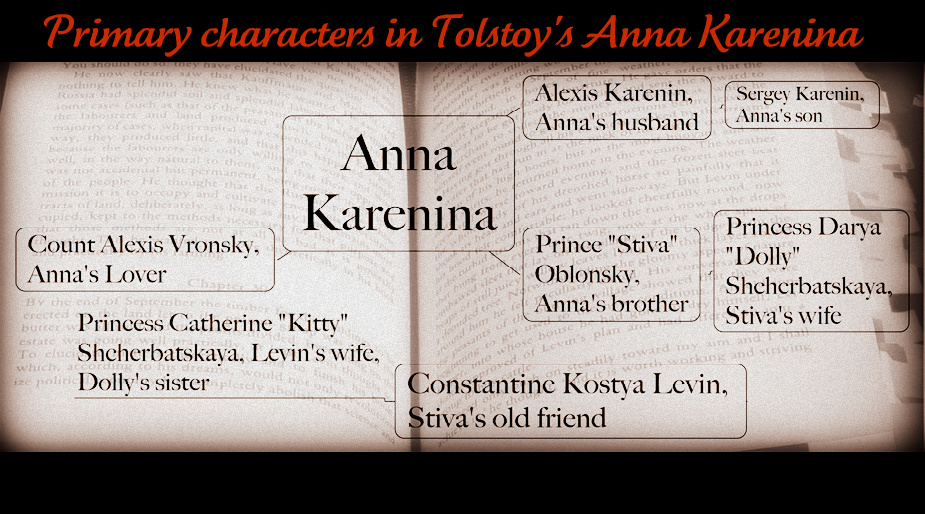
Image created in MindMap Manager, Anna K book as backdrop & edited in Picnik.
If I had not known the title of this book, would I have concluded Anna to be our protagonist? I wonder. She seems no more and perhaps even less central than Levin at times. Both of them occupy the main seat nearly as often followed closely by those surrounding them, Karenin (Anna’s husband), Vronsky (Anna’s lover), Kitty (Levin’s wife), Oblonsky (Anna’s brother) and Dolly (Oblonsky’s wife). Tolstoy is generous with his pen toward many characters; throughout the novel’s 8 parts, friends of friends, servants and nurses, counts and princes, distant characters and lengthy conversations, take us away again and again before bringing us home to Anna.
Perhaps Anna is indeed reflected through each of these characters and the society around her as my reading partner Rebekah observed below (paraphrased below) when I complained about lack of Anna’s overall “stage time” :
Yes, where is Anna!? With this author who writes an entire world, she is reflected in his world. The theme stated in that first sentence, The Family, means we’re watching poor Anna in contrast to how easy it is for Oblonsky to be unfaithful, the measure of Dolly’s happiness with her children, the unmarried characters’ emotional expectations (or not) of marriage and what personal resources they will or will not have when marriage can or cannot fulfill all their hopes for happiness, the exact nature of the society that is the terrain Anna and Vronsky meet in, must swim against, and will or will not fall heavily on them.
Tolstoy’s deep exploration into each character psyche aside, we do not even meet Anna right away! The novel opens with the unfaithful Oblonsky waking up to his own infidelity’s consequences, mustering up courage to meet the disappointments incurred to his wife Dolly, a matter which he finds quite surprising! We see how easy it is for Anna’s brother to be unfaithful and the socially accepted terms and forgiveness afforded to him even by his own wife, ironically, thanks partially to the advice of visiting sister, Anna. The twisted irony which follows is anything but humorous.
Tolstoy on Mother Nature:
It is impossible to dismiss Tolstoy’s devotion to nature in reading Anna K. When I watched the incredible film, “The Last Station”, the last year in the life of the author, this virtue was evident in all his actions. His vast descriptions of farming, nature, the woods, the rise and setting of the sun, are as breathtaking in prose as the nature itself he describes. It is possible that Levin represented a lot of Tolstoy himself, especially for two occasions which the novel repeats what Tolstoy himself had lived: Levin not having the right clean shirt before his wedding to Kitty and therefore being awfully late as well as a fun silent word-game Levin plays with his beloved Kitty to convey his thoughts without expressing them, all of which she guesses. Tolstoy is known to have done both of those in his own life. On a more serious note though, the prologue draws parallels between Levin and Tolstoy where politics and Russia’s land ownership philosophies are concerned, topics which I could appreciate as I read and waited with baited breath to reach Anna again in the story.
Tolstoy on Marriage and Infidelity:
It is not clear to know where Tolstoy stands on these delicate topics. We know from his biography that he was estranged from his wife at the very end of his life and that is all. On infidelity, he shows us Oblonsky’s quiet acceptance of his own actions and his wife’s suffering and forgiveness; their life together goes on nonetheless. Then we see Anna who commits the act and suffers miserably, desperately and hopelessly falls into despair, a fate neither her lover nor her husband come close to experiencing. Was Tolstoy showing us the blatant hypocrisy of society in treating a cheating married man versus a cheating married woman? Was he implying that it reflects his own thoughts toward infidelity as how it should be? I doubt the latter and therefore choose to believe the former. When my friend Rebekah, distraught at the fate of poor Anna, wished for a different ending, it was all I could do to think that it would simply not be the story it is. We human beings seem to crave tragedy even if we flood it with compassion and sympathy.
“Vengeance is mine; I will repay”. The epigraph to Anna Karenina comes from the bible (Roman 12:19, King James version) but the original meaning seems to be thwarted. It must have dozens of translations for Tolstoy never explains who is to take the vengeance and who repays for what she/he did. We can only extract our own meaning and I am choosing not to analyze it to death (I can hear cheering from all of you!
). Well, since Anna is the heart and soul of this masterpiece to me, it must be Anna. Indeed, toward the end, she seeks vengeance on Vronsky who could neither fulfill her anymore nor contain her paranoia and she does so by repaying with the biggest price of all, her precious life. In weaker parallels, Karenin at one point wanted to seek vengeance on Vronsky but did not carry it through and Lydia, Karenin’s companion, sought some vengeance on Anna by not granting her the divorce she so badly needed to gain her freedom.
Reading is the best pastime for an active mind! If you like to see the other book reviews, check the index of In Print.
Random Musings of the Heart about Anna Karenina:
In every page and passage of Anna Karenina, I strip through a rainbow of emotions and I do it again on the following page. There is either the amazement from descriptions which brought everything and everyone to life for me, the amusement from observations on culture, society and humanity, the enjoyment of brilliant dialogue and the movement from immense articulation of feeling and thought; there is the thrill of short-lived bliss preceding the compassion and sadness for those suffering from one of life’s harsh turns, or simply the sheer joys of reading a pure and timeless classic, Tolstoy’s Anna Karenina.
Tolstoy was generous in a great many aspects with Anna K. but he left me starving in one. In an unforgettable essay by Simon Blackburn, he writes “Lust subverts propriety; it stole Anna Karenina from her husband and son and Vronsky from an honorable career.” Blackburn builds up this lust in his imagination and I suppose so should I because Tolstoy leaves all, and I mean all, to imagination where Anna and Vronsky’s affair is concerned. I regret so much not being able to know in Tolstoy’s words, Anna’s exact moment and nature of giving in to Vronsky and any or all subsequent moments of lust, pleasure, joy and sensual bliss. Alas, Tolstoy affords us no such details as I learned quickly when he jumps forward to a scene where the two are already together: “That which for nearly a year had been Vronsky’s role and exclusive desire, ….; that which for Anna had been an impossible, dreadful but all the more bewitching dream of happiness had come to pass.” (Chapter 11, pg 175). Subsequent scenes of Anna and Vronsky remain chaste and pure with so much implied, leaving me wanting more of Tolstoy in this one regard.
In Madame Bovary, one of my favorite classics, Emma is selfish, conniving, exploratory, soul-searching and always putting her own pleasures forth before those of her lovers or anyone else in her world. No matter, I still loved Madame Bovary for her bold, courageous, and undaunted pursuit of her heart’s many desires but alas, she is nothing like Anna K. Our Anna is love and compassion, sadness and confusion all in one. She has been so deprived of love and affection in her marriage that she is near starvation when she finds herself in Vronsky’s arms. She is both the sinner and the victim in her own affair. She is all beauty and allure, with a softness that melts every heart and an aura about her that captivates all who come in her contact. She is a mother in love with her son (but not her daughter from Vronsky) and unable to choose between him and her lover. She is a fawn in desperate need of love, a fallen woman whose guilt consumes and confuses her to utter despair and hopelessness. She lives a short burst of happiness, sadness, love, bliss, confusion, grief, vengeance and most of all, a tragedy. She is Tolstoy’s most unforgettable figment of imagination and will live indefinitely in my heart.

Closing Comments by me and Opening the floor to you:
It is impossible to do justice to this work of literature in one post. I wanted to share a handful of the countless memorable passages here but instead I have decided to create an audio podcast reading them for you! So watch for this in the very near future. In the meanwhile, please feel free to start a conversation in the comments below, share your thoughts about Russian literature, classics, Anna Karenina, or any other musings you may wish to dispense for all of us to read and enjoy. I look forward to reading and responding to each and every one of you.


{ 48 brilliant comments, Care to add another? }
Well, you are quite prolific, Farnoosh. I am amazed at your depth of knowledge here. Reading this was quite enlightening for me as I am not well versed in Tostoy.
I can say that the greatest thing an artist can do is inspire creativity in someone else. That is why I love reading, music and art… it inspires me to express myself authentically.
Hi Rob, indeed Tolstoy is prolific and aspires me to be so as well. It was my very first experience with Tolstoy also but not nearly my last…..
And thank you for the definition of an artist…..so true.
Wow. Brilliant analysis on what I’m sure will be a great book. I picked up Anna K from my shelf yesterday and started reading it… Will let you know when I finish and what I think of it
It is a phenomenal book but it requires patience as it is long and in depth and should be enjoyed and not rushed….It will test you even though I know you are an avid reader. Please, please do keep me posted especially if Tolstoy grips at your heart like he did at mine. Thanks Brett!
Anna K. is a truly amazing novel. I was lucky to read it in Russian and I must say Tolstoy is definitely the best novelist that has ever lived, along with Dostoevsky. But I should also note that while Anna K. is probably within top5 of the best novels ever written, I would rank Tolstoy’s another classic “War and Peace” even higher. I read it before Anna K. and now thinking back, I think it impressed me even more. I definitely recommend it to you. If you loved Anna K., War and Peace will be revolutionary for you. I am looking forward to your review of that book.
This post was top notch. Good job. I was mildly shaking in excitement when I was reading this post, as I was remembering the emotions I felt while reading the book.
Dear Anzor, thank you for sharing your wonderful thoughts. Oh I am reading War & Peace but I am saving it for the winter so I can savor it. I think my life is just a little chaotic now and I want to entirely focus on War & Peace. And Crime & Punishment of course, although my Russian friends hardly think Dostoevsky is at all in the same or even high ranks of Tolstoy – I am sure opinions vary but oh am I so glad to hear your reaction to the post. Many thanks for stopping here!
Thanks for the reply.
I also know many Russians (I am myself from the country of Georgia, former republic of USSR, and interestingly we currently have strained relationships with Russia, but that won’t change my admiration for genius of Russian novelists of course) who are not really fans of Dostoevsky, while they passionately love Tolstoy, as they claim that Dostoevsky’s novels are very gloomy and depressing, which is true, but nonetheless, I think “Idiot” and “Brothers Karamazov”, which I have recently finished reading are on par with Tolstoy’s biggest novels. For what I know, I could relate to Dostoevsky’s novels to greater extent than to Tolstoy’s novels.
Anyways, they are both amazing and I am so happy to have found the time to read their work.
Good luck!
I can’t wait to get into Crime & Punishment and for the sake of this discussion alone, I’ll do a compare and contrast between the two….To imagine another author that may come close to Tolstoy, now that makes my day! Thank you Anzor for sharing your thoughts. Feel free to see my other book reviews and enlighten me more
!
What an interesting read! It just goes to show just how diverse and busy Anna Karenina really is!
Though I have to say, it was interesting that you should bring up Emma Bovary. There were several points where I found both characters to be very similar, particularly in that melodramatic approach they have towards their relationships. Anna was certainly more charming and likeable than Emma, but (as in every great tragedy) I love them for their flaws.
Bethany, Anna K. is never dull. And I love how you put it, we love them for their flaws. I wrote in length about Emma too and I can’t understand why I would love these women especially for all the melodrama. Thank you for sharing your thoughts.
Hi Farnoosh,
I’ve read very few classics. My daughter read this book when Oprah recommended it. I’m going to visit her in Atlanta next weekend. I’ll get it then;)
I’ll let you know how it goes;)
Tess, how exciting that you will read Anna K. Tell me which translation she has when you get it. It’s a long read and I am so glad Oprah also recommended it. Enjoy and let me know how you like it….
Hi Farnoosh.
Your reading habit is superb.
It was interesting to hear that it was easy to read. I’ve seen the book many times in the classics section of bookstores, and I would assume it would be somewhat difficult to read, even though I don’t know if I looked inside.
Your point about its themes fitting in with current times makes sense. There are some themes that don’t go away, regardless of changes in technology, because they are linked to us as people.
It is cool that the book evoked such emotions on each page. I can barely remember any books that have done that for me. I do sometimes feel glad about uncovering certain information from a book, though, so that is not that dissimilar.
I haven’t read any books this large, but that is probably because I basically only read non-fiction books that are mostly around 150-300 pages.
Great review.
Armen, self-improvement and business books are great. Just look at my “business books” tag. I used to eat them up! But what do you read for fulfillment and joy? Tolstoy was very logical with pure breadth and depth of language but not in a showy, flashy way. Every word and phrase serves a purpose. He is phenomenal. I highly recommend you pick up a classic in the very near future. The classics are all free now if you have a kindle or an iPhone app (a free app, Stanza) because all the libraries have provided them to the masses…..good luck and thank you for the thorough comment!
Hey Farnoosh
Like you, I picked up Anna K, eager and motivated I read consistently for about four days, and life happened.. now it’s collecting dust :/
However, your in depth analysis of this book really got me excited to finish it!
Looking forward to sharing with you what I think
_-Parker
Parker, don’t worry – I had one lapse in reading Anna K., but it was emotional. It was too much purity and beauty in prose to digest so I stopped reading until I watched “The Last Station” and then once I started it back up, there was no stopping until Tolstoy stopped writing….Do do do come back and tell me what you think please! I envy what awaits you. Enjoy it.
I like the tender care you put into details — especially your image of the primary characters. It’s a great mash up of visual + text + elegance.
J.D., “tender care” – sweet words. Thank you. That is exactly what I wanted to deliver as a small token of thank you for the beauty Tolstoy bestows us in his writing.
Blimey, so the Anna K comment on my InfoPreneur post wasn’t a gag, it was for real! I haven’t read much Tolstoy, bar W&P, Anna K, Resurrection and maybe a couple of others that, shame on me, I’ve forgotten me. One thing that has always struck me is how his ideals come through in everything he writes. One thing that made me sad is that when I read one of his biographies I got the impression that he was dissatisfied and miserable in long periods of his life – but perhaps that is the way with idealists.
Ah, no, I do not kid around about Tolstoy or reading in general
! So you have read War & Peace or no? And what do you mean you’ve forgotten? Sigh, perhaps I will too with enough time. Best thing is that I am reading a lot of classics now, later in my life, and I write about each on the blog so perhaps it can stay with me longer. And oh yes, most of the geniuses of our time were unhappy people. Such irony and such sorrow. Thank you for your first comment here, Mo!
Farnoosh -
You’ve done it again with an in-depth and passionate exposition of Anna K. The work you put into your posts is astounding. I love your passion about the novel, but even more your extraction of the lessons we can all learn from Tolstoy. Outstanding work as always – look forward to hearing your extracts from the book.
Phil
Phil, how I love your compliments
!
!
Seriously thank you for recognizing the work that went into it and delighted that you will be listening to the podcast. Now I just need to do it
Great name (blog and personal), great photos. Delighted to connect with you out here in the blogosphere:)
Thank you Annabel Candy – and as you know, I am very happy to have discovered yourself.
HI Farnoosh,
I read Ana K a long time back…and loved it then. Then I read it again…when it was on Oprah’s book club list. And I enjoyed it even more…somehow every-time i read it..it gets better and better…amazing!
Thank you for sharing your vibrant love for literature here…I have to get to the nearest bookstore soon….I’m itching to read some classics now
Much love,
Z~
Dear Zeenat, I am envious of you already – having read Tolstoy not once but twice. I am saving War & Peace for the winter and then delving into more Russian lit before moving to other classics. Delight in whatever classic you pick up….and much love in return.
psst…thanks for adding me to your awesome blogroll…You are on mine too
http://zeenatsyal.wordpress.com/linkblogroll/
Hey, you are the one making me smile today – to be in such great company – thanks Zeenat!
Dear Farnoosh.
Great classics observe life and show us a mirror don’t they?
This is still so true for most women; “Our Anna is love and compassion, sadness and confusion all in one. She has been so deprived of love and affection in her marriage that she is near starvation” and I think that is why classics are classics, they are still describing what we see today.
We can only hope that one day these classics are like total fiction of a time long gone in which humans have not yet found themselves.
Love Wilma
Dear Wilma, welcome here and thank you for sharing your thoughts. Yes, yes, they are describing what we see today – you said it so well – and maybe that is why we appreciate it more the older we get. I don’t know why classics are enforced in high school when we can hardly come to love them (more at least) as we do later in our lives. Love the mirror analogy. Thank you much for saying all you did!
Wow, Farnoosh. I think you liked Anna Karenina! LOL. I finally got around to reading it about 4 years ago, and loved it too. My sense is that not long after this one he started becoming a bit polemical and didactic in his works whereas in AK his ideas still largely come through the story (albeit various characters do pontificate at times). I’ve started War and Peace about 3 times, but each time life has got in the way. I enjoyed what I read each time – that is, I wasn’t put off but it was just that I wasn’t in a position to commit the time needed. It’s still on my TBR pile. I WILL read it one day.
I do give away how I feel about Anna K. just a little bit
!
– what then? He put such an effort, such a life into it, the least I can do is read and write a gratitude to the world about it. If you want to partner up with me on W&P in the winter, let me know!
I am not surprised that W&P was hard to finish. I think it’s more than natural for life to get in the way of these long novels. I had a lapse of 3 weeks or so during Anna K. where I simply stopped reading – I think it felt a bit too much to read it too so I took a break – but I sometimes think about the authors: What if Tolstoy just gave up half-way – and he was writing this stuff not reading them
Thanks Farnoosh and apologies for the late reply – your response came in the day my Dad turned 90 so I was a little busy! That’s a lovely offer to partner-read W&P, but I think I’d better say no. Your winter and my winter don’t coincide I believe (you are in the USA aren’t you?), and I’ve agreed to partner read another novel with a friend this winter (which is almost upon us down here). I think that will be enough of a partnering commitment for me at present – I fear if I took on more I’d let someone down! But again, thanks so much for suggesting it.
No apology necessary – and I am in the US yes so if you are in Australia (sigh how I miss it), then I suppose you are coming on to winter. I really respect the way you commit and it’s very similar to how I do it – especially if I am committing to others.No worry. Finish your novel with your friend and I am going to twist someone else’s arm to keep me company in W&P. Thank you whisperinggums!
Thanks Farnoosh … do you have a connection to Australia? I wasn’t sure but wondered? Anyhow, yes, I am conscientious about commitments so try to be careful about making them. I’m glad you understand. Good luck with finding a partner – I look forward to your review when it comes.
Actually my contact is in the same timezone with me..Rebekah, she also read Anna K with me and has of course read W&P at least once if not more but she is willing to go along for the ride. I do have Aussie friends through work in Sydney and I cannot wait to return. My first visit in 2005 left such an impression. Hey maybe that can be the next travel post and you can keep me honest?
! Thanks!
Farnoosh,
Even less comme-il-faut than wishing for a different ending (namely that a violent, helpless act of anger destroyed all their love forever) is my pure anger at Tolstoy for creating such a completely destructive imaginative experiment with Anna’s character and fate, but this personal reaction is only proof of his power as an artist. Artist’s choice, reader’s choices — entire worlds.
Thank you again for getting me to read this with you. What a pleasure to see your review, and, as we can always expect happily, a seductive introduction to the novel!
R
Rebekah, I know – I know, I know (on the ending)! The power of an artist indeed. And the pleasure was all mine; I stole all of it from you I think because it was an immense journey to take together and I love to read War & Peace together in the winter if you like. “Seductive introduction” – that makes my day!
Hi Farnoosh ! – This is a very innovative modern analysis of Tolstoy’s ‘Anna Karenina.’ I must admit that I am so pleasantly surprised . Tolstoy has always been considered as the greatest Russian novelist, not without a reason. Chekhov who is my favorite Russian writer had a tremendous respect for him and used to prepare himself very carefully before seeing Tolstoy.
They both commented on Shakespeare, joking that the comments around Shakespeare are in a sense even more important that the formers works. In between Chekhov was Tolstoy’s favorite.
Anna Karenina is a fantastic novel and a great reading that allows deep insights into human nature. It has to be read at least three times to reach the
necessary level of understanding. Tolstoy, Chekhov and I.Bunin are I would say the most profound and unsurpassed analysts of the woman’s heart and mind. Thanks.
Hello Michael, are you originally Russian? I envy that you have read Tolstoy in Russian, if I am guessing correctly – and thank you for sharing your favorite authors with me. I am always looking for new. I shall look Chekhov up. I know that Tolstoy was extremely respect among very well-known authors, both his contemporaries and those who came after him. Oh how I would love to read Anna K. again. Unsurpassed is the best way to describe it. Many thanks for sharing these dear thoughts on dear authors with us here.
Hi Faranoosh ! — I am Bulgarian and participate in J.D’s blog. I have been thoroughly educated in the U.S, and have worked even with Nobel Price winners. Of course that I know Russian and their classic literature very well.
Chekhov and Bunin are the greatest in short story writing and have influenced
the whole world,especially Anton Pavlovich . I can only advise you to study them. You will be enchanted. Anna Karenina +War and Peace are Tolstoy’s
greatest achievements as a novelist. You may look into Nabokov’s – Lectures
in Russian Literature to gain some insights and guidance. Speaking about these novels I feel exactly as Bunin(the last Russian classic),who when asked
what he thinks about Pushkin, answered -’I don’t even dare to think about him!’.
Hi Michael, thank you for indulging me for more about you. Welcome to prolific living and thank you so much for sharing your insights. I am reading the Wikipedia entries on Chekhov and Bunin now. I have never been into short stories but then again I may not have had good ones to read…..I can’t wait to read War & Peace (in the winter in a few months) but I must say, since you mentioned Nabokov, I could not for the life of me get into Lolita. I gave it 3 fair tries at 3 different times, esp. since I liked so much “Reading Lolita in Tehran” and I was not able to go past 50 pages, I regret that I could not appreciate Nabokov, even though my Anna K reading partner, a true literary, adores him. Well, welcome again. I have so enjoyed this conversation.
Hi Farnoosh ! – I have never read Lolita in my life,nor was interested in the movie. However Nabokov’s book ” Lectures in Russian Literature” – is a different case, since he seems to know what he is talking about. I am taking my time before I write you a feed- back comment on your A.Karenina analysis. This is something really serious and I need some time to think things over. For me Chekhov and Bunin are better than Tolstoy, but I read all of them once. I tried to read Chekhov a while ago, but without the preliminary success. I figured out that you are Iranian, so I can tell you that some of my closest friends in Philadelphia for more that 30 years are Iranian. A Iranian family(Bulgarian /Iranian ) – close friends of mine, live in Iran and are fantastic experts in Rumi, a poet that I worship. Rumi I read permanently and quote him in J.D’s blog
once in a while. I also enjoyed the conversation and your thoughts that I find most relevant. Your comments are about to better at least War and Peace, where Tolstoy devotes 20 -30 pages to describe a big ancient tree. No one except professional experts will read such thick books now days. Thanks.
Dear Michael, I am Iranian yes and funny you mention ancient Persian poetry because my Anna K partner, Rebekah, is in love with the Shahnameh so we had my Dad read unbelievably gorgeous passages in Farsi by Ferdowsi and then we moved on to Saadi’s Gulistan…..and Rumi is of course another eloquent one……I appreciate the kind words here. I am mesmerized by the new findings and will not have enough time in this lifetime to finish reading the beautiful works but try, I shall. Come back anytime to share your thoughts on Anna K. in more detail please. And I will be doing a recording podcast of some of my favorite passages in the future also. All my best. Thank you.
Dear Farnoosh, – I showed your splendid article on Anna Karenina to a friend who has the reputation of one of our top experts in classical Russian literature and has specialized in Russia.. He was so impressed by your innovative and completely fresh view, understanding and fine feminine feeling of this rather complex literal character! He said that your fantastic handling of the English language far surpasses Tolstoy’s when writing to his editors.
Good for you. We both felt very proud.
Again, Michael, you really flatter me. I would love to hear your friend’s thoughts so please tell him to feel comfortable sharing them here as well. Your kind words made me very happy when I read them, sorry for tardy reply as I was away. I seriously doubt I could surpass in any way shape or form the supreme artist that was Tolstoy but glad to have made you both proud. On to War & Peace in a few months!
You should read Pushkin’s Secret Journal 1836-1837
Thanks for the reference, Sok.
{ 9 brilliant comments, Care to add another? }