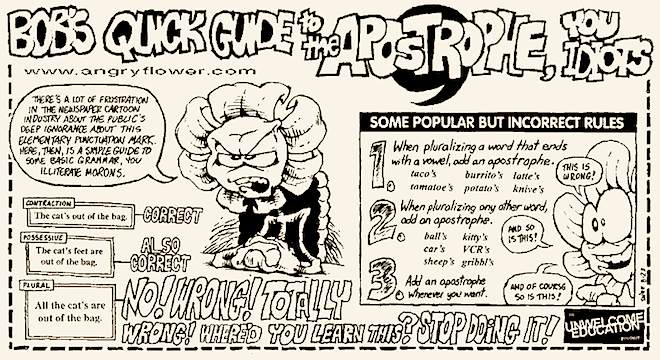
“You idiot” might have been one of the first phrases I learned in English. It was not necessarily directed at me. It was often directed at the little boy sitting next to me in class in Turkey and spoken loudly and clearly by our disgruntled British teacher. In that classroom, our written and spoken English needed to be clean, crisp and always correct. Brute force teaching methods aside, I have never lost that sense of respect and responsibility toward the English language.
I started to learn English at the age of 12 in Ankara, Turkey. My mother tongue has always been Farsi. I had to take a year of Arabic while still in Iran. The move to Turkey made it imperative that I learn Turkish fast and furiously for survival. If I don’t count the German lessons during the same school year, English was the third language to which I was exposed.
I suppose it’s stuff like this that makes you obsessed with the language or leads you to write an 8200-word Writing Manifesto to give away for FREE to your readers. Who knows?
I did not go on to major (or minor) in English. I studied Engineering and went to (gasp!) public schools all the way. Yet I have never ever used any of this as an excuse to write off the use of English language as one of my weaknesses. Instead I use it as a powerful story to prove that it is critical for all of us, particularly those of us living in English speaking countries, to be able to speak and write using proper and polished English.
English is not an easy language to learn, I admit. It is easy enough to get started but it can take several years for the wacky expressions and phrases to become second nature to a foreigner and there is a long road to achieving excellent flawless writing skills. All of us are somewhere on that path. Nonetheless, it’s supremely important to follow the fundamental basics of English. Shocking and frustrating as it may be, this simplicity is becoming more the exception than the rule. Hence in this article, I hope to shift the trend with your help:
I write this post for the love, purity and beauty of the English language as it was meant to be written and spoken.
I write this post to save us the unnecessary embarrassments, the silent expressions of disbelief and perhaps even the potential clientele and revenue. We are fabulous and brilliant and these mistakes are simple to avoid.
I write this post so that I can share it rather than my usual standard emails with the next friend or stranger who needs a gentle reminder for what she/he already knows.
I write this post so that I stop sending people to my all-time favorite cartoon, Bob’s Angry Flower, the funniest and closest expression to my state of mind but perhaps one that is not very helpful!
I write this post to help stop the growing insanity of our deteriorating language and engage all of us in preserving the purity of the English language.

So without further ado, I implore you to remember these 19 Significant and Simple rules every time you put pen to paper or finger to keyboard:
1. its vs. it’s
its = a possessive pronoun. Examples would be: The puppy is going to find its toy. The computer and its power supply are for sale. Do you know whether my car needs its own inspection?
it’s = contraction of it is. Examples would be: It’s much too hot in July. I think it’s going to rain. I doubt it’s ever going to be the same.
Easy reminder: You can replace it’s with it is every time and re-read your sentence for meaning.
2. there vs. their vs. they’re
there =an adverb, in or at that place. There is only one lemon left. There should be an easier way to do this. There is nothing quite like it.
their=a possessive pronoun. Their mansion is beautiful. Their olive trees make me dream of Italy. Their baby cries a lot.
they’re=contraction of they are. They’re simply stunning. They’re going to perform for us. They’re not here yet.
Easy reminder: You can replace they’re with they are every time and re-read your sentence for meaning.
3. lose vs. loose
lose = a verb, to come to be without something; to suffer the loss of something. I do not wish to lose more weight. I was about to lose my ear ring. She cannot stand the thought of losing him.
loose=an adjective, free or released from attachment; not bound together; not strict. My belt is very loose around my waist. She likes to wear her hair loose and free. That is a loose interpretation of our document.
Easy reminder= Lose has come to be without its extra “o”!!!
4. whose vs. who’s
whose= possessive form of who. Whose plans are these? Whose money did he take? Do you know whose boat we saw the other day?
who’s= a contraction for who is. Who’s going to clean all this mess? She was wondering who’s going to dance with her. Do we need to tell them who’s going to be there?
Easy reminder: You can replace who’s with who is every time and see if it makes sense.
5. your vs. you’re
your=possessive pronoun. Your job is very exciting. I wish I were in your shoes. Did you tell me your secret yet?
you’re=contraction for you are. You’re going to amaze them with your performance.I want you to know how much you’re delivering for us. Perhaps you’re about to get started?
Easy reminder: You can replace you’re with you are every time and see if it makes sense.
6. write and right.
write=verb, to express in writing. I want to learn how to write well. Did you write this? Write a letter to Mom
right=adjective, correct, justified, suitable, opposite of left. The little boy knew right versus wrong. It’s the right way to do things. I meant to write this for you right away.
7. me vs. I
The best explanation for this rule is here; nonetheless here is a simple explanation:
I=subject. Me=object. Which one to use when?
Let’s learn by example:
1. This would be wrong: They are going to send my wife and I a package.
Why? The rule is that the sentence should make sense if you remove the person and preceding the I. So in our case:
They are going to send I a package. This is obviously wrong. It should be: They are going to send me a package.
2.This would be wrong: Jim and me are going to the beach.
Why? Remove Jim and. In this case, also adjust the verb to match single form of first person. Then re-read the sentence:
Me am going to the beach. This is also obviously wrong. It should be: Jim and I are going to the beach.
3. This would be wrong: The best one is sent to Ashly and I.
Easy way to remember this is that I does not follow a verb. I should always make sense if it is followed by a verb.
Correct form would be The best one is sent to Ashly and me.
I am rather pleased to learn that my favorite phrase, “it is she“, upon answering the phone has formal correctness on its side but is rather antiquated
8. effect and affect
effect=noun, produced by a cause; a result. The effect of your leadership is visible here. The rules are in effect as of today. What if the change has no effect?
affect=verb, to act on; to produce a chance. She affected all of us with her speech.The cold weather affected my plants last night.I let the movie affect me deeply.
9. accept vs. except
accept=verb, to take or receive. I accept the challenge. They accepted the generous gift. Why not accept our flaws and still love ourselves?
except=preposition, excluding, save, but. Everyone except me decided to go. Do anything you can to please her except calling her. Except for her attitude, I think she is ideal.
10. gone vs. went
Both are past participles of the verb to go.
Correct: I went to the store. I should have gone to the open market instead.
Incorrect: I should’ve went somewhere!
11. the apostrophe disaster for plural form
The most common error is to put apostrophe where apostrophe has no business. When you form a plural for nouns, there is no need whatsoever to add an apostrophe.
These are all wrong forms of plural nouns = Cat’s, Dog’s, Lot’s (not even a word), ABC’s,
Plural forms in most cases are made by simply adding an ‘s’ to the singular form = Cats, Dogs, lots, ABCs.
Even though the use of apostrophe before an S in pluralizing an acronym is quite universal, it is still incorrect.
12. ending sentences with preposition
It has also become common to use prepositions inappropriately or to end phrases and questions with prepositions.
Examples of some prepositions: at, of, with, in.
Wrong: Where are we at with our plans? Where is the movie theater at?
Correct: Where are we with our plans? Where is the movie theater?
When asking about the location of a place, “at” should not be used after “where.”
Note: Don’t confuse phrasal verbs which make up a huge category in English language and are best described here. For instance, a preposition always is used in the phrase “to hang out” (where did you want to hang out?) and the verb wouldn’t make sense without this preposition.
13. the dangling participle
The dangling participle can seriously change the flow and meaning of your writing. It is important to make sure we qualify the intended words.
Examples:
Misinterpreted: Cooking on the stove, she decided it was time to turn the vegetables.
It sounds as though she was being cooked on the stove herself.
Better: She decided it was time to turn the vegetables which were cooking on the stove.
Misinterpreted: Sunburned and dehydrated, mom decided it was time for the children to go into the house.
It sounds as though the Mom is sunburned and dehydrated.
Better: Mom decided it was time for the children, who were sunburned and dehydrated, to go into the house.
14. could of vs. could have
This is very simple. I’m afraid “could of” is not even a phrase. It is often misused perhaps because it is phonetically so close to “could have”
I wonder if I could have majored in English.
15. here vs. hear
here=adverb, in this place; in this spot. I am here and planning to stay. I wish you were here. It is here in this place that we met.
hear=verb, to be within earshot; to perceive by ear. I hear you. We do not want to hear the policies one more time. If only she heard what he had to say!
Easy reminder: Here is There with a preceding T and the two are almost opposites so think of them in a pair.
16. irregardless vs. regardless
This is very simple also. I’m afraid “irregardless” has never and will never be a valid word. It is completely made up. It’s not going to join the ranks of words regardless of what we do!
17. then vs. than
then=adverb, at the time; immediately or soon afterward. I will eat; then I will go. He shall see you then. If you want to be there by then, you had better hurry.
than=used after comparative adjectives. He is taller than she is. I wonder how much more than this I can pay. Will you please speak louder than them?
18. to vs. too vs. two
to=preposition. If you want me to do this, I will. You should be prepared to go.
too=adverb, also. They want to perform too. She too has one. So will they see you too?
two=noun, one plus one. I want you two to decide amongst yourselves. If only the two of them could see you. How long before you two grow up?
19. were vs. where vs. we’re
were=past tense of verb to be. If I were a rich girl, I would live in Italy. You were happier then. I think they were going to stay.
where=adverb, in or at what place. Where were you last night? Where can we go from here? Where in this world did my dog disappear?
we’re=contraction of we are. We’re going to be famous. We’re not there yet. We’re about to make a huge difference.
Well, my friends, this is by no means a comprehensive list. This is just a list of most common errors which I see and find easiest to avoid. Writing and learning has never been easier. We are a click away from a dictionary, Wikipedia, thesaurus and English language resources all over the web. I think as humans, we all err at some point or another. The goal is not to become infallible. The goal is to become aware and conscious of how we use the English language and to strive to be the absolute best we can be.
In my parting thoughts, I leave you with 8 quick suggestions that can help you avoid these terrible pitfalls:
- Proofread your writing. Always.
- Proofread it again if you are going to publish it somewhere.
- Have a friend or a peer proof read it with a critical eye for oversights and errors.
- Use a dictionary and thesaurus when you have doubts.
- Train your spell checker to kick in before you send or publish anything.
- For long documents, walk away from them for a little while and come back with a fresh mind and critical eyes.
- Find a way to tell others when you see these mistakes. Always do it in private. Best to praise in public and criticize with kindness in private.
- Always be open to feedback and receive it with kindness.
Let us not allow poor writing skills overshadow our brilliant potential.
Let us not succumb to the everyday disasters in the language and just follow the crowd.
Let us turn the tide and care about the way the English language is spoken and written.
Let us preserve the beauty of the English language.
A penny for your thoughts:
This has been a passionate topic for me for years. Please share your thoughts. Add to the list of common errors!
Tell us what you find aggravating about the use of English language? Would you tell someone if you detected these errors in their writing?
Knowing that irony has a sense of humor, I would not be surprised if one of you caught an error here in this article even after I proofread it 5 times! Please do leave a comment if you do!
You may also like:
Why We Never Fly without Using ExpertFlyer:
Finally a service that decodes the complexity of airlines fares, ExpertFlyer is the best service to find premium seat availability and to get the inside scoop to maximize our chances at upgrades.


{ 103 brilliant comments, Care to add another? }
Great Job! These things were always a problem for a non-native speaker like me. Though, it’s going to take me some time to absorb these grammatical rules.
Dear Donnie, from one non-native speaker to another, believe me I hear you and it takes a while and you can always use this reference. Thank you for reading this post.
Nice list, though I disagree that “went” is a past participle. It’s unfortunate that many native English speakers get some of these wrong. Seeing “loose” in place of “lose” drives me crazy.
Nathan, you are right. It is a past tense of “go”. Oh yes, the “loose” abuse drives me crazy too. Send them this article next time
!
Hey Farnoosh,
Your English is pretty perfect for someone who only started learning it at age 12. I couldn’t speak a word of English when we moved to South Africa and I was plonked into an English school. I had no choice but to learn it very fast or else I simply would not be able to speak to people.
Great explanation of simple lessons for non-native English speakers
Cheers
Diggy
Hi Diggy, I know what you mean about having to learn it fast for survival. Thank you for the compliments, the Retweets and for reading!
Thank you!! This post will help me with my english!!
Wow! I was impressed to read that you speak more languages!!! I used to study Arabic 3 years ago …I like it, but I found it really difficult!! I like the arabic calligraphy, I thing it’s a kind of art! It really fascinates me!!
Have a nice day!
Thank you dear Laura!! Arabic and Farsi can be art. I did not mention that I no longer remember my Arabic, German or Turkish even though I studied them for years. I do however speak French now and needless to say, I am crazy about Italiano and a few other languages!!
Really interesting to hear about your experiences Farnoosh and thank you for this comprehensive post. I studied English at GCSE and A-Level but since starting writing again last year, realised what bad habits I have got in to! I am working on my grammar so it’s good to have this post to read!
Jen
Thank you Jen. I am so happy you stopped here to read this and please share this with everyone that you think may benefit from it.
Great post! One error I see a lot is using then when it should be than instead.
Oscar, tell me about it. Send the post to our friends and let’s correct it one at a time together!
I once put “coarse” on a resume.
Oops
!
One of the hardest things to catch by your own proofreading is ambiguity:
“The iPhone does everything other smart phones do better”
Perfect! Absolutely perfect! And ever so true. I stand corrected and I’ll rephrase it. Thank you for reading!!!
I admire your passion for the English language, Farnoosh. For the benefit of those who might wish to pursue the topic further, perhaps you could include a list of useful books and articles to read. Thank you for this beautifully written article.
Hi Saleh, thank you. Great suggestion. Perhaps I can dedicate another post to just that topic. Thank you for reading and welcome to this space. Happy to have you!
Regarding your eighth point, “effect” can be used as a verb. This probably adds to the confusion. Effect as a verb means “to bring about” or “to accomplish” as in “to effect a change.” I am not helping your cause, am I?
Indeed it is. I admit it is not as common but it is a verb as well. So thank you. You are absolutely helping the cause: You are reading this article, you are sharing your thoughts, you are pointing out other ways to use a word and making me smile! Thank you Barry!
Hi Farnoosh
I’m English and I’ve learnt something.
What about practice – noun and practise – verb (same as advice and advise).
Gets me every time.
Fortunately for you American spelling is always practice.
I have an unpaid assistant to proof read my posts… my wife!
Keith, oh you English people with your love affair with the “s”. We moved over to the “z” and haven’t looked back since..but I like to mark the subtle differences and of course I am just giving you a hard time. What a nice wife she is! I bet she is more thorough than my previous editor-in-chief (husband) who recently got fired for multiple oversights
!
Great post!
I can’t help myself!
You have:
Note: Don’t confuse phrasal verbs which make up a huge category in English language and are best described here
I have two suggestions for you. You’re missing an article, and you also need a “,” before the “and” since that sentence fragment is a complete thought, even though the subject is implicit and not explicit.
Also, it would be nice to see you discuss “which” and “that” with respect to restrictive versus nonrestrictive subordinate clauses.
To that end, I’m afraid the following sentence is actually incorrect.
She decided it was time to turn the vegetables which were cooking on the stove.
“which” should be “that”. The reason for this is because there is a crucial piece of information being offered; thus, “which” is inappropriate because “which” implies parenthetical nonrestrictive subordinate clause type information. You clearly were going for a restrictive subordinate clause.
For a detailed discussion on this, please see http://www.worldwidewords.org/articles/which.htm
Keep up the great blogging!
Clearly, you are right. I will keep my response to a minimum lest you decide to rip it into shreds.
! Thank you Sina. I actually did consider talking about “which” and “that” but I did some reading and it has never been terribly clear which to use when! Thank you for the lesson and for all your insights and especially for picking on me. I like that I can generate conversation with my writing! Come back to visit more!
Farnoosh, This is a very well written and timely article. Even native English speakers can benefit from it. I worked in the Southwest of China as teacher, and educator. I taught English, and prepared students for VISA interviews. It was challenging, and rewarding. I find your posr very valuable, well thought out, and composed.
Continued Success!
Joseph, what a challenging job you have. I can’t imagine the patience it requires! Thanks for stopping by and for sharing your thoughts. Continued success to all of us with language use
!
I love the angryflower pic!!! I want to second your recommendation of On Writing Well because it is quite an excellent book. You hit everything right on with these 19. I agree with you that using these well in the written language is a must. What’s really hard is speaking these points well (obvious written errors aside, of course). You only get one shot and no proofreading when you are face to face with a person or a crowd and end in a preposition or mix up me and I. I don’t tell just anyone about errors, but I have informed a blogger friend about a misuse of a word in a common phrase once. (Oh, and yes–I found one here, too ; ) Good job on this post!
Oh the angry flower is a classic, Leon. I am glad you agree on Writing Well being an excellent book too. I am sure I left a few things out but these are the 19 that strike out the most.
On the speaking bit, you are quite right. One chance. One shot. Better get it right! So nice of you to comment here, Leon! Thank you.
I am a non native English speaker from the other side of the world and loved your post. I read it this morning in the email format and came back to it now on your blog as I really need to read it through slowly and assimilate all the various “wrongs” which I may be quite guilty of, though without my conscious knowledge. Thank you for this post
Mystica, I am touched how far the post has reached – the power of blogging continues to make me smile! Thank you for stopping by, for enjoying and learning and do not hesitate to share this with anyone and everyone!
Nicely done Farnoosh! I think it’s these little things we all get muddled up from time to time. My grasp of English is pretty good and yet I still make occasional errors in my grammar!
Hi Amit, thank you thank you! The little things that make the big difference. It’s a learning path forever for all of us. Thanks for stopping here!
Hi Farnoosh.
These sure are errors that aren’t appealing to see. There are many native English speakers who make these errors. They come up way too often. It is good that you targeted this issue.
I have proofread papers for many people, and a few make so many errors that correction takes longer than writing the paper from scratch probably would. For a person who sees these grammar issues as maybe not being worth the investment, remember that each correction saves hundreds of times of making the mistake later.
Also, one motivating factor for folks to want to correct these is that they look foolish making these errors, so the sooner the errors are corrected, the sooner they can not look foolish.
Armen, the first draft of why we should not make these errors indeed had the phrase: it makes us look stupid but my husband had me scratch it out. I wanted to make sure that I give strong reasons without being terribly brutal about the truth. Sometimes, the most brilliant among us have the oversight and if the ones who care about the person refrain from telling them, it won’t put them in the best light when it matters, because of course we afford them the benefit of a doubt but it should follow with the correction!
Thanks as always for your insightful thoughts, Armen!
Farnoosh -
I love your zeal for the English language. My mother was an English teacher and she would approve of your lessons. You’ve shared some of the most common pitfalls out there and I’m sure it will help everyone to write more clearly and effectively. Great article, which obviously took a lot of work. Thank you.
Phil
Phil, I bet your mother had her moments of frustration but thank her please for such a difficult job from me and I am sure many others!! Thank you for saying hello and supporting the cause
!
I just had to comment on this post. It is a peeve of mine that the english language so many of us have been speaking from the time we were a year old is not used correctly. Now, before I go much further, I have to admit that I’m not the best at keeping my grammar and spelling in check but, I do make an effort to ensure what I write is correct.
Where incorrect usage really seems to stand out for me is in Facebook status updates and group/fan page names…
Kudos on a great post,
Darren Sproat
Darren, welcome here, and thank you for your comment (and the Retweet!)
Indeed, in status updates in social media and text messaging, the language falls apart. I sometimes make exceptions for text messaging but not for social media where everyone can read the update. Pet peeve is not even the word for me but alas, all we can do is be the best role models possible and slowly change the trend. Thanks for sharing your thoughts!
Nice post! I think it’s really useful, especially for such bloggers as we are. My native language is not English either, but I blog in English.
But, I started to learn English at school being 6 years old. And besides, now I’m a translator, linguist, it perhaps was the reason I started to blog in English.
Thank you for this post!
Roman, welcome here and thank you for encouraging me further on this post. A linguist would be my dream job. I LOVE languages. Thank you for sharing your thoughts and come back again!
Dear Farnoosh, very interesting post indeed and very useful! Thank you and thank you for your lovely video! I am downloading it and can’t wait to see the whole! I must say you are quite a professional in Yoga, not like me! but the video has inspired me to practice more! Thanks again and take care…
Dear Leila, you are very, very welcome. I am so happy you enjoyed the post here and the yoga video. I have another one coming to the website soon with a blog post. If I can inspire just one person with my yoga, I think my job is done. Keep practicing and THANK YOU for taking time to a leave comment. Be sure to tell me your thoughts on the other yoga videos already on the blog….
Hey Farnoosh, thanks for this English lesson. I’m taking an English exam this weekend and this might come in handy. I especially learned something new on tip #4, as I never knew exactly what “whose” meant or why it was spelled that way. Now I know! Thanks for sharing this and helping me out with my blog comment from you in our little chat today.
Hulbert, it’s above and beyond what I wanted to achieve if I can help improve test scores here You are most welcome! Thanks for stopping by and best of luck on the test!
Thanks for this post, I am from India and English is not my native language that’s why sometimes i get hard time when it comes to writing a post in English.
As you may have read, neither is it my native tongue and you are quite welcome! Practice and reading lends itself to a lot of progress!
LOL!! Pretty good stuff, Farnoosh! Whenever I travel and speak English to someone who does not have it as their first language, I try not to use all the slang expressions that are in common use. When I write, I bend the rules a bit as I want to engage the reader as if in a conversation.
I know a German couple who both speak English. She learned it in school and is very correct with her usage. He learned while working at a US military base and speaks it more like I do, lol!
By the way, my dad has been to Turkey many times and loves the country.
Hi, thank you Dr. J. You are so kind to do what you do. I exercise that for my Japanese colleagues as well. Those who learn English in European schools usually learn it in pretty correct form but then again, these errors are born somewhere and I am going to find out why
!
Yes Turkey was nice in hindsight. Thanks for stopping by!
Hear, hear! I’m with you all the way on this one, and my love of the English language is one of the reasons I try always to read material that is well-written. My only caveat about your entry is more in the nature of an observation than a disagreement, and it has to do with #12. If I remember the story correctly, someone once took issue with Winston Churchill — a master of the language if ever there was one — for ending one of his sentences with a preposition. To this reproof, Churchill responded by writing, “This is nonsense up with which I will not put!”
Hi Gary
Good point you make:
“…Winston Churchill — a master of the language if ever there was one — for ending one of his sentences with a preposition.”
I think that only applied to his speeches because we speak in a much less formal way than we write.
When I’m coaching people to give speeches I tell them to forget the grammar book and just say it the way we do when we talk.
If you try to talk the way you write, it sounds overly precise and stilted.
The great opening line from Star Trek – “To boldly go” – is a split infinitive but sounds much better than “To go boldly”.
One of the big problems of writing a speech is to write it for the ear not the eye.
I totally agree with Keith too. Sometimes, there are eccentric ways to say things and yet in the written form, it’s not entirely accurate. Really, I would be happy if people oblige to say the first 5 of these rules
!
Also, you might want to go look at my latest blog post, which is about one of my favorite books of all time, one I would highly recommend if you have not read it yet.
Gary, too funny on your Winston Churchill example – and thank you for the laugh and for your comment here. I am glad we share the love of English language. I agree, #12 can be tough to use and our language has become so used to ending phrases with prepositions. So for that one, many exceptions are allowed, how’s that?
ps: Will check into the book on your blog. I wonder if it’s On Writing Well, which I have read…..
On Writing Well — is that the one by that Zinsser fellow? If so, I have read it, too. My favorite chapter was the one on humorous writing.
Farnoosh / Garry
“On Writing Well” is a must have book for any writer or speaker.
The book is full of great advice and examples.
“Strip every sentence to its cleanest components.”
“Use nouns and active verbs not adverbs and adjectives – Spare us the news that the winning athlete grinned widely.”
Brilliant book – thanks for the reminder.
Time to read it again.
It is a great book, Keith. You may enjoy my book review of it….In fact, I’d love to know your thoughts…
On Writing Well book blog.
Thanks for those reminders!
Farnoosh, I think this might be of special interest to you: I have indeed read On Writing Well, but no longer have my copy of it. Someday I should buy a new one, and probably will. However, shortly after finishing it, I decided to mail my copy to a young friend in Iran who is working on her masters in English literature. I’m sure she has been putting the book to good use!
A very sweet story, Garry. It’s making me wonder if I now should send my copy over to Keith who has not a copy of his own….
Great list! I’m not a native English speakers either, and try to improve my English through daily use and writings. I think my biggest problem is the confusing use of “in”, “on”, and “at”. Also still not quite gripping it correctly when I should use “a/an”, “the”, or nothing, in front of a noun.
I love your section about irregardless! (It’s not going to join the ranks of words regardless of what we do!)
Hi dear Dina,
).
Ok it’s simple as far as a/an and the. When you are referring to any apple, nothing in particular, you say “an apple” or if you are referring to any friend, you say “a friend” but if you want to make it a particular one, a specific one, you use “the” – “the friend who helped me”, “the apple which I ate”, “love the weather we had yesterday”…..if you replace a/an in any of those then it’s not specific what we are referring too…(are you more confused! I hope not
So nice to see you here and thank you for the kudos!!!
Yea… I remember those rules and feel like I already apply them. But when my supervisor return to me my thesis draft full with those “a/an”, “the”, and “use nothing” correction…. ouch!! Still keep practicing and hoping to get it correct naturally. My problem with that is not as severe as the “in, on, or at”
Tough supervisor, Dina…..I meant to come back to this comment but never did….All I can think is read read read – and it should be easy since you are on the road so much (trains, planes, etc)….and share what you learn with me
!
What about my pet peeve – misusing the dash!
Incorrect: The boy is red-haired.
Correct: The boy is red haired.
Correct: The red-haired boy went to the store.
Or this one:
Incorrect: If I was a rich man …
Correct: If I were a rich man …
oh I use that last one all the time…’you mean “I were”, not “I was”, right?’, – blank stares in return. Then I have to sing that silly song…..
Thank you for adding such value to the conversation for us, Kim!!!!
Thank you SO much for this post!!! You are a marvel! English is not my mother language either and I try very hard to do a proper job with it – I am striving to be perfect, not always succeeding, I know, yes, but being aware! I always proofread, and ask my husband to proofread for me, my blog posts and I try to write good English in my e-mails and letters. My mother language is German and I always felt very hurt about the many mistakes people make with it! Language is a beautiful thing, the best way of expression for human kind – we should cherish it, love it and be proud of it!
I stumbled on your blog today by chance and I absolutely love it. It is full of riches with an abundance of interesting topics, ideas, and advices! I will follow it from now on!
Hi Yael, I am so happy we share the same ideals and passions for the language. And I never thought about your perspective but you are right. Even with me, and even if English isn’t my mother tongue, I am hurt and angry if someone (who usually knows better) makes serious mistakes and oversights with the language. Your English is superb and I am thrilled to have you on board as a new reader! Welcome
!
“Affect” can also be a noun!
Yes it can! Thanks Josephine (great name you have)!
I was really surprised about your 19 rules. I am not a native speaker and I don´t live in an English speaking country but following those 19 rules has never been an issue to me. They are so basic and simple that anyone who does not know and follow them can´t rightfully say he speaks English.
Katharina, the best comment of all. Believe me, nothing could have prepared me for the shock when I like you left a non-speaking English country and learning English as a 3rd language live here to encounter the horrors done to the English language. Believe me, it happens often and I love your boldness. Indeed the rules are simple and yet they are constantly broken. Hence my feeble attempt at restoring some purity back into the language. Thanks for sharing your thoughts!
You’ve provided a very valuable tool. I can send this post to my co-workers and not have to nag individuals about their specific issues. Thanks!
Carole, please do share it with as many people as possible. You make my day by spreading the word. Thank you so much and so happy to have you here on the blog among the readers! Welcome!
Thank you for the reminders Farnoosh.
I share this passion of writing clear, concise and uncluttered English with you.
Always happy to welcome a new lover of the English language on-board, Abubakar!
Farnoosh.. thank you for this excellent and thought provoking post!
My personal fears are held for that dear little oft forgotten word “who”. Who was it [that] said “who” was no longer an important little word?
The sad truth is that “who” is very quickly being replaced by the ubiquitous “that” in common language and I fear that it won’t be long before its use disappears forever.
CORRECT “the person who” not “the person that”
The day this little word disappears from our language forever will be a sad one for me because “who” has always done such a good job of separating people from objects, things and places.
But I suppose it is inevitable. History has already demonstrated how remarkably quickly language can change in accordance with the people who are articulating it. The trend will no doubt continue into the future aided and abetted in no small part by the confluence of digital media into the mix!
But it l b gr8 m8 [chuckles]
Thanks again Farnoosh… I share your sentiments entirely… and take heart and immense joy from the fact that we are not only in this thing together but both on the same page as well! Keep up the great work
Jean
PS I wonder if “could of” has evolved from the contraction “could’ve” which sounds like “could of” when you say it. What do you think?
Jean, thank you for sharing your passion of English here with me in your own words. Yes, “who” should be used instead of “that” – perhaps it has been less obvious of an error to me in sight of such violent other errors that shock me. “Could of” drives me insane. Where did these people learn English? Yes it is a similar sound to “could’ve” but since when do phonetics tells us how to spell? It is very sad to see the decline of the good use of English and I am always going to be a huge advocate – a loud and unapologetic one – for people to use their better judgment than follow the [wrong] crowds. Thank you for sharing your thoughts!
Farnoosh, this is a great list… In my work in essay editing, I have found that native English speakers still make many of these mistakes, but are less eager to see them corrected than non-native English speakers are. Perhaps our interest in learning proper English is the fuel which helps us preserve it!
Last Fabulous Post by Ryan was 4 Packing Questions I Have for Experienced Travelers
Thank you Ryan. If there is one post I want to promote to death, for the sake of preserving whatever is left of our English language, it is this one so please, spread it. Yes, you are also right in that the English speakers sometimes are nonchalant about learning to correct their mother tongue’s mistakes. How ironic indeed. Thanks for dropping by and hope to see you again!
Hello Farnoosh,
This was such a wonderful reminder. Sometimes as a writer, it’s (see I used that correctly) easy to get lazy and use words outside their proper usage, just as when we talk.
Thanks for quickly reminding us that we should want to use the English in its proper form.
Alyx.
Last Fabulous Post by Alyx Falkner was There’s Always A Bright Side- Even In The Darkness of The Night
Dear Alyx, hi! I have spent all day writing a long writing manifesto and I have leveraged some of these tips. I am so glad you enjoyed this. It is the one post and one set of tips I want everyone to adopt! And YES, you used it’s and its properly….very proud of you!
Learning English is much like riding a bicycle: you can pick up enough to get by quickly, but it takes decades of effort to become Lance Armstrong.
You think? I wasn’t asking people to become Lance Armstrong, I was asking them not to keep falling off those bikes
! These are the foundations of the language, not lessons for becoming an author. Sigh, I think it’s an upwards battle for me and I may just learn to live with these errors. 
Thanks for all the comments here, Scott.
By using proper English and combining that with a large vocabulary, I was usually able to talk my way out of trouble in school. There are plenty of words that sound nice but are actually insulting; using them in a proper way let me tell a bully exactly what I thought of him while he believed it was a compliment. On the other hand, the reverse is also true: if I said your prose was replete with pulchritude, what would you think I said?
Oh I know the trick of which you speak and as far as replete with pulchritude, I’d have to bow and say thank you, right?
Thanks Scott! Fun conversation!
The same class that showed “The Secret” also showed “Akela and the Bee”. That’s where I learned the definition of “pulchritude”. It sounds terrible in English, and yet it’s complimentary.
Having recently read Time magazine’s review of the “Tiger Mom” book, which I am considering reading, there is something to be said for the rote memorization method. I believe my children will be attending home summer school, in which we will all have vocabulary quizzes. As shown in the movie “Akela and the Bee”, there is far more to spelling than simply memorizing how to spell; by also learning the etymology of the words, as well as their definitions, you learn not only when to appropriately use a word, but its conjugations and make it easier to learn still more words.
On the other hand, it’s far too easy to get full of ourselves. On the sitcom Growing Pains, the daughter wanted to work for the school newspaper, and was delighted to get the job, until she learned it was not her brilliant prose, but rather the fact that she could spell. The teacher supervising the paper told her her writing stank, but at least she could spell. When she protested, he informed her that she was right, her writing didn’t stink, it was “replete with stinkyosity”. Whenever I get particularly proud of something I’ve written, I remember that scene and Theodore Sturgeon’s Law, which is that 90% of everything is crap (and some folks say he was an optimist). Considering that the Pareto Principle (that 80% of value comes from 20% of whatever, for example, 80% of sales tends to come from 20% of customers) has similar numbers, I tend to agree. So, I try to create the best quality crap I can.
Good and entertaining reply here, Scott. Thank you for taking time to entertain and educate here….I never got into spelling and can’t bear to watch the pressure on kids who go through spelling bees but it’s super important to learn about etymology of words. I wish I had that much time
!
I need to read and re-read you’re article every time I right.
I wish I had your eye for the discipline of the English language. Looking forward to receiving your Manifesto!
Hi Brandon, so glad you enjoyed the post but were you being ironic or are these honest oversights? Since it is fitting to our topic, I will point out:
It should be *your* article rather than *you’re* article (which reads: *you are* article!). And I know you meant “write” rather than “right”. Indeed, do pay attention because it’s a shame if you have a great message and pollute it with these errors. Best of luck!
Farnoosh-
I was being ironic. These errors are quite possibly some of the most annoying errors in the game. Even with this knowledge, I still struggle with accept and except, its and it’s and a few others.
Thanks for your response.
I love your 28 questions on your writing voice in the Manifesto. Well written!
Oh goodness, I can’t tell you how relieved I am. Great job teasing me, Brandon!
Thanks so much for coming back and I am *so* thrilled that you like the questions on the manifesto!
Hi Farnoosh,
Thank you for calling our attention to these common writing errors. Words are magical! It’s important that we write them right! …or should I say correctly?
Just a couple of slight corrections: your, their, its are not possessive pronouns but possessive adjectives. Just a question of grammatical function; your examples are correct.
‘Loose’ is not only an adjective (‘his clothes are loose’) but also a verb:
set free; release : the hounds have been loosed.
• untie; unfasten : the ropes were loosed.
• relax (one’s grip) : he loosed his grip suddenly.
Two of MY pet peeves are 1) the misuse of ‘like’ when ‘as’ is called for, i.e. whenever it’s followed by a verb: ‘AS the president said last week…’
and 2) the misuse of the indicative where the subjunctive is called for: ‘It’s essential that the budget HAVE enough money for welfare… ‘ (not HAS) or ‘I insist that he BE on time’ (not IS).
In my 40+ years of teaching French at the university, I have found that non-native speakers of English like yourself are generally more aware of good grammar than native-born speakers, no doubt because you learned it in a conscious fashion. Keep us the good work!
Last Fabulous Post by Brian Thompson was EVNews April 2011
Dear Brian, welcome to prolific living – and I must say that normally, I love comments but I particularly delight in getting comments on THIS post, even a year later. Thank you so much for the corrections. I love the extra details and I am delighted that you also love French – about to reply to your comment on my French passions post. I think the non-natives simply fear being left behind so that fear drives our desire to succeed
! Thank you so much again for stopping by.
One common term used in a few Asian countries when one has a cold is a running nose instead of a runny nose.
Anne, too funny – thanks so much for this lovely and fun addition to the list here.
Don’t know if this was mentioned above but,
Less vs fewer
Everyone uses less when fewer should be used. “There were less people in line today than there were yesterday” (like how I got a few of your typical error words in?)
Less can only be used when there is one object or group. Fewer is used for individual items. For example, ‘fewer rice grains’, ‘less rice’.
There were fewer people in line…
I have less money today…
I have fewer quarters than I did before…
Mew, that’s a brilliant addition. Thank you so much! This is why the comments complete the post. Thanks also for the great examples.
Obviously, as a writer, I love this post. And while I realize that it is conventionally tolerated as an appropriate way to speak/write, I also abhor the split infinitive.
Last Fabulous Post by Ruth – The Freelance Writing Blog was The Lady Gaga Guide To Epic Freelance Writing
I split an infinitive once but I had to tape it back together because I couldn’t stand the screaming.
Ha! That’s precisely why I hate when people do it, Scott! I guess I’m an infinitive activist.
Last Fabulous Post by Ruth – The Freelance Writing Blog was The Lady Gaga Guide To Epic Freelance Writing
Oh dear, I think I am guilty of this one but on purpose. I like to say that it’s a writing style, for instance, I may say “To boldly go where no one has gone before … ” but alas, Ruth, now that I know this one also falls in the category of “error”- I honestly did not know, then I will watch it. THANK YOU for coming by!
No worries Farnoosh – it’s technically an error, but today, it’s widely considered acceptable. It bothers me – but that’s probably because I majored in English and I can’t let go of the ‘rules’. Your writing is beautiful – especially considering that English is not your first language!
Last Fabulous Post by Ruth – The Freelance Writing Blog was The Lady Gaga Guide To Epic Freelance Writing
Oh I don’t ever use that as an excuse- that English was my 3rd language
– and if it’s an error, I won’t be making it again ….! Thank you, dear Ruth, and I so wish I had majored in English instead of electrical engineering! Sigh…..
{ 12 brilliant comments, Care to add another? }