Why to Read the Classics: Celebrating our Literary Heritage

30 comments . For the Soul

Aside from a handful of reading assignments in high school and a few beloved thick classics which slipped through, I turned my back to literature and the classics for the sake of science, engineering, and a career in technology.

How on earth would English Literature or any other classic help me toward excelling in grad school or getting the next promotion?”, I thought, tossing aside even the remote possibility of engaging in such an activity. Quite rightly, it probably would not have helped me. Jane Austen or Emily Brontë would have never been instrumental in writing my thesis on “Effects of pulse shape on performance of Direct Sequence Spread Spectrum Multiple Access communication systems“! Or in getting that next promotion, for that matter.

Be it singled-minded ambition, naïveté or ignorance of youth, in hindsight it is best I set aside the novelty of that experience for another time and place.

When my reading mania started a few years ago, I traded insane hours of unnecessary work for a few hours of reading pleasure and low and behold, an insatiable desire was born. From business books to thrillers, from best sellers to personal memoirs, from fables to self-improvement works, I have been on an expedition of the finest kind and yet have only recently arrived at the sanctuary of it all: Classical literature.

Don’t get me wrong. I devoured every word of Dan Brown’s Da Vinci Code, Daphne du Maurier’s Rebecca, Mario Puzzo’s The Godfather, Michelle Moran’s Nefertiti, and Michael Crichton’s thrillers amongst dozens upon dozens of other delicious reads.

But when it comes to a true classic, the conversation changes. All scales of standard measure are rendered irrelevant. We are no longer just talking about a book, a work of fiction, a plot or a promising movie from Hollywood. We know we are in the presence of something timeless, eternal, and special.

Definition of literary classic (which may be up for debate!) : An original work that has continuously and consistently stood the test of time, withstood the winds of change (cultural, political and historical in nature) and endures still for all generations as a universally recognized jewel to be read and treasured.

Jane Austen, Emily Brontë, Leo Tolstoy, Gustave Flaubert, Henry James, Edith Wharton, Victor Hugo, Alexander Dumas, Charles Dickens, Edgar Allan Poe. And this is just to name a few.

Equipped with a pair of untrained eyes and a background unsuitable for understanding the arts, I am shamefully ignorant of the delicate layers of meaning behind all the literary prose. Yet I have been undeterred and unstoppable. I read each classic cover to cover, word for word, with the exception of Wuthering Heights and most of Tolstoy’s passages, which I read twice. Even as I struggle with the dreadful beginnings, the incredible depth of vocabulary, the unrecognizable references to history and geography, I am awestruck and stunned to the core with the pure genius behind the power of these silent words.

I nurse a healthy appetite for the contemporary reads but temper a yearning lust for the classics.

And where are these classics today besides old bookshelves of the world? Outside the circles of the literary minds, college lit courses or a formal book club, do we talk about them? At work, at cocktail parties, on the phone, in email, or in daily routines with friends or strangers, do we discuss them? Do we bring the characters to life, learn from them, apply their lessons, imagine their struggles, or imitate their beautiful dialogue?

It is madness to allow our intellectual worldly heritage to be left to oblivion. Let us pay tribute, respect and gratitude by celebrating the works of timeless literature inherited by us. It asks nothing of us, only to be read and remembered. A world of toiling and labor from the tireless hands of the mastermind authors to our undeserving hands. Seize the golden opportunity to educate and enlighten your mind. Read timeless classics.
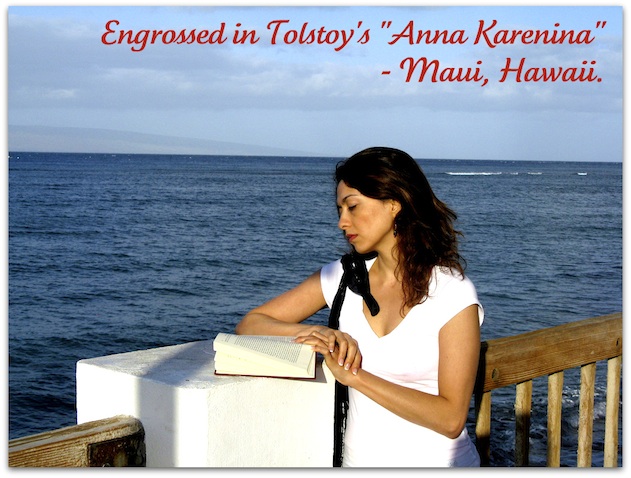
Anna Karenina in Hawaii

And in case you are as stubborn as yours truly, let me set aesthetics and intangible ideals aside for a moment and convince you that reading classics will change your life and improve upon your mind. I claim that just as classical music opens up the synapses to help you with mental clarity and creativity, whatever your disposition in life, you shall reap similar rewards from reading a classic once in a while.

Consider, if you will, a few of these practical benefits:

Creative Thinking: The authenticity of each author, the blueprint of each style and prose, and the mesmerizing characters and their plots will awaken a sleeping mind. With an active mind buzzing from such original works, you will create a universe of possibilities for your mind to think through ideas, plans, and problems.

Originality of Ideas: From the breadth of ideas articulated and expressed ever so precisely in each classic, you will give birth to your own original ideas. The behavior is contagious. The inspiration remarkable. And the possibilities abundant.

Raging Inspiration: The classical authors often went against the tide. Women writing under a pen name because they felt compelled to express themselves. Writers who chose a life of writing, dying penniless and poor but believing in their work. The audacity to write, to create a lasting piece of work, to leave something behind. If that does not inspire you …

Precision of Expression: There is such articulation of each feeling, thought, and idea. Such precision and attention in the absence of vulgarity and obscenity. There is the ordinary and common way to express ideas and there is the refined and unarguably better way. Classics can show you the latter.

Stories to Prove a Point: We learn in college and at work to use stories to prove a concept. There is no better place to learn an abundance of thousand year old stories than from the classics. Using the timeless characters as analogies to get your point across can be effective, impressive and memorable.

Knowledge of History: Reading pure history books takes amazing patience. Putting history in the context of fiction can make it memorable for longer periods of time. Encapsulating it in the beauty of literary prose of a classic makes it simply impossible to forget!

Enhanced Vocabulary: The sophistication and purity of the writing demands our attention. The prolific vocabulary is remarkable in these classics, and you cannot help but pick up new words, new phrases, and perhaps use them in your speech or writing. Words which have graced these pages but have disappeared from our language, to be sadly replaced by commonplace chatter, slang, or nothing (in which case a string of words is used to describe a situation for which we used to have perfect vocabulary to choose from!)

Never another Grammar Mistake: The frustration of today’s common grammar mistakes will cause me to act out of character in public one of these days. It continues to appall me. It is important to speak and write well. Even if errors in grammar have become a common everyday occurrence, they are still wrong. Dead wrong and poor usage of language. Classics can teach us to avoid them like the plague.

Fighting Adversity – Most of the classics were written at a time when life was quite hard and earning a comfortable living with a fraction of today’s luxuries was reserved for a lucky few. The characters in most of these works of fiction struggle and continuously fight adversity. They share with us their lessons, their hardships, their frustrations and often their triumphs. Even if things happened many decades or centuries ago, the human spirit fights the same battles in a different battleground today – if not in our environment, then we bring it onto ourselves with stress, challenges and personal pursuits. We can learn perspective and perseverance.

“When you re-read a classic you do not see in the book more than you did before.  You see more in you than there was before.”  ~Clifton Fadiman

What classics in literature have left you with an indelible impression? Why? Which ones did you love? Which ones did you hardly stand – and if so, did you ever go back to read them again? And is there a way we can make reading classics a more standard pastime in our lives? Share your thoughts!

This post was influenced by a dear friend, Rebekah Smith, whose love and adoration of the classics is beyond impressive and whose understanding of them inspires me to look deeper into each book and each author. I draw inspiration from her insightful perspective and I tease her because her modesty is as abundant as her vast literary knowledge. Thank you, Rebekah, for sharing your passion with me.

Why We Never Fly without Using ExpertFlyer:

Find Airline Award & Upgrade availability Finally a service that decodes the complexity of airlines fares, ExpertFlyer is the best service to find premium seat availability and to get the inside scoop to maximize our chances at upgrades.

Care to engage with me beyond the blog?

If you like to engage with me beyond the blog, I offer 1:1 Sessions. Also, sign up on the top right for exclusive content and sweet offers that do not show up on the blog. I'll send you A Manifesto for Writing Well for free as thank you.

{ 19 brilliant comments, Care to add another? }

1 Armen Shirvanian March 6, 2010 at 8:43 PM

Hi Farnoosh.

I sure notice the classics anytime I pass by them in the bookstore. I have read a few of them. Native Son by Richard Wright comes to mind. Also, The Great Gatsby is one I remember reading. There are a lot of them that I haven’t read, though. I have always had a tendency to go mostly for nonfiction books.

Your descriptions of their benefits sure is the whole set. They sure are very different from the books of today, and have strong messages that we can use today. It is sort of like Mozart’s music, which is centuries old, but still hits the same tone today. Many of them sure did take a heavy stand compared to what we see today. A valid message stays a valid message(at least until some huge change takes place).

They certainly aren’t made for short-term gratification. Reading classics is mostly for long-term wisdom gains.

I can see them becoming more popular through some form of modern release form. I’ve seen services online that send a chapter of a book a day to an e-mail address, like from a classic book, which is good, but it is still not so appealing to some. I’m not sure how to make it more of a user-friendly item for those who are not too into the classics.

Reply to conversation

2 Bob Weisenberg March 7, 2010 at 12:00 PM

Hi, Farnoosh.

I agree with almost everything you wrote here. It’s why I switched from an Engineering to Literature major after my Freshman year in college.

However, everything you wrote about “classic literature” applies to the best modern literature as well. A book does not have to be old and musty to have all the wonderful qualities you attribute to the classics. The best 20th century literature the exact same thing.

If you’re interested in a very entertaining and highly readable guide, see “The Salon Guide to Contemporary Authors”

Bob Weisenberg

Reply to conversation

3 Laura Cococcia March 7, 2010 at 12:40 PM

Wonderful post! The classics can be daunting, but you share many reasons why they are so important. I particularly like the part about learning about history in a way that’s interesting, within the context of fiction. Beautifully written, as always Farnoosh!

Reply to conversation

4 Bob Weisenberg March 7, 2010 at 3:16 PM

I find it more useful to think of it in terms of “Really great literature” and “Just OK literature”. Some modern works are truly and recognizably great now. And some of the “classics” are overrated as literature just because they happened to have been important historically or because all works by a “classic” author are considered to automatically be classics even if they are weaker than their best work. Just my way of looking at it. I expect great literature to enthrall me, not bore me.

Bob Weisenberg

Reply to conversation

5 Farnoosh March 7, 2010 at 2:47 PM

@Armen, thank you for the comment, and I did not know about that service- emailing you a chapter a day. While I would not give up the books, if it makes others read more classics, the more power to them!
@Bob, what would be the fun if we agree? Just kidding! Actually, I had a long discussion about this with my husband about what a classic, what is literature, and what defines each, and in 100 years from now, what of our time will be added to one set or the other. Is classic literature a subset of all literature or is literature a subset of all classics? Thanks for the link!
@Laura, thank you for the kind words. Interesting word! I never thought of classics as daunting, but boy are they challenging, and certainly try our patience at times.

Reply to conversation

6 Felipe (Phil) DeGuzman March 7, 2010 at 11:06 PM

This is a great post! I was an English minor and have been a lifelong reader of classics. Thou I tend to include older novels in my connotation of classics: Shogun and Atlas Shrugged for example satisfy my criteria.

One interesting thing I learned about five years ago is somthing called Project Gutenberg. PG is an effort to digitize all unlicensed domain works. So my reading has taken a strange twist: I read classics in eBook format (first on my Palm Tungdten, now on my iPod touch).

While most people I relay that information to cringe at the thought of my having read all of Ayn Rand’s most influencial works on a 3″x5″ screen, I find the form factor much more comfortable than a 1000 page book with a nightlight attached.

What’s on my iPod now? Recently finished “sidartha” by Hermann Hesse; “relativity” by Einstein, working through the Old Testament, then the Iliad and The Odyssey.

Reply to conversation

7 Farnoosh March 8, 2010 at 7:15 AM

Felipe, exciting that you use your electronic gadgets for such a novel use! In defense of those books, it doesn’t have to be a nightlight attached. You can read them in broad daylight…. :) but point taken, and of course the whole point is for people to read the classics, media used is irrelevant. Love the choices here. No light reading for sure. Enjoy!

Reply to conversation

8 Rebekah Smith March 8, 2010 at 9:59 AM

Farnoosh, your book reviews have been a constant pleasure to read; you open the pages of Firdowsi and Sa’di to someone who could never hear them otherwise; you have me reading Anna Karenina. It’s you who are the inspiration. Favorite authors can become our best companions in life, but reading with friends is just as sweet. Thank you!

Reply to conversation

9 Greg Blencoe March 8, 2010 at 2:42 PM

Farnoosh,

Fantastic post!

This definitely inspires me to read a lot more of the classics. Unfortunately, I have read only a few so far. But now that I think about it, it might be a lot of fun at some point in the future to take a couple of years to travel around the world and read the classics while doing this!

The one main thought that I have about the classics is that they make us deeper thinkers. They just take us to a place intellectually that we haven’t been before.

This is true for the only two books that I have read that I would classify as classics. And that is “Atlas Shrugged” and “The Fountainhead” by Ayn Rand. There were times in both books when I could almost feel my mind growing as a result of what I was reading because it was so good and so true.

I don’t know if this makes sense of not, but this is the best way I can describe it.

I think the best way to make reading the classics more standard is to have conversations just like this. When you share your enthusiasm for these books, it can inspire other people to read them, too.

Reply to conversation

10 Farnoosh March 8, 2010 at 2:58 PM

@Rebekah, you have only my Dad to thank for in regards to the Persian poetry. I am just a bystander that is marveled with the process! On Anna K, of course, we are in tight agreement!

@Greg, I devoured Atlas Shrugged and The Fountainhead when I was 16. I loved the stories, the philosophy and the characters so much I think I am going to read them again after getting through Tolstoy. Do read more classics. Traveling the world AND reading classics is my best pastime and I highly recommend it. Thank you for being inspired!

Reply to conversation

11 Bunburina March 10, 2010 at 8:43 AM

Aloha Farnoosh:

Just imagine you under the sun in paradise reading Anna K. It’s prolific living indeed.

Perhaps you should think about getting the Kindle. It’s not the same as having a book in your hand, but it’s very handy to have all those books in a little gadget and it is so easy to carry it around especially when you travel.

Thanks again for your thoughtful post. Looking forward to reading more.

PS. I don’t know that Ayn Rand is required reading in high schools. It’s sad that the students do not seem to get her message.

Reply to conversation

12 Adam March 12, 2010 at 12:19 AM

So many classics are definitely worth reading. I find that while I may not necessarily love the book while reading, I tend to notice references/allusions/mentions of it later on.

I’ve considered getting the Kindle so I can keep my books with me, but I’m not ready to give up the comforting feeling of pages in a book (ones that I can bend the corners & scribble on) just yet.

Reply to conversation

13 Farnoosh Brock March 15, 2010 at 9:07 PM

@Bunburina – So nice of you to call my reading Anna K prolific! Nothing could describe Leo Tolstoy more accurately. I might just pick up the Kindle sometime. I am just not ready yet, I so love my books….Oh and Ayn Rand is no small discussion – suffice it to say, I loved her when I read her in my teenage years.

@Adam – I feel the same, and I end up always changing my mind after the beginning of the classics. I am not yet ready either to give up the comfort of those beloved books.

Reply to conversation

14 whisperinggums March 26, 2010 at 9:58 AM

What can I say but, you go girl! I too love “the classics” – with Jane Austen being a particular favourite. She’s the one I reread most often – because I’ve read them all – but I also like Dickens, Hardy, Gaskell, Wharton, James, Camus and the list goes on. They are, indeed, beloved books BUT it is often hard to get people to give them a go.

Reply to conversation

15 Farnoosh May 11, 2010 at 7:46 PM

Gosh how did I never respond to this? Thank you! I remember so well reading it. I want to thank you for that list. I am in such need of even MORE classics (and more time to read them alas!)! Well, as for people, once they read something worth their while, they are hooked. Problem is getting them started!

Reply to conversation

16 DonnieZazen May 11, 2010 at 7:18 PM

You truly enjoy the classics when you blend in one of the characters. When you read it loudly, when you get into the character, when you reenact the novel. The experience is like the taste of sweetest essence go down your throat. Sadly, I sold my love of classics for worthless school education and elite career.

Reply to conversation

17 Farnoosh May 11, 2010 at 7:47 PM

Donnie, do you mean when you imagine yourself as the character?
And it’s sad to sell that love – what price did you get for it -and why can you not read classics anymore? Ok that’s one too many questions…but you piqued my curiosity!

Reply to conversation

18 DonnieZazen May 11, 2010 at 8:06 PM

I am not sure if this story is true but lets go for its spirit. Tolstoy, while walking down the stairs, was imaginatively talking to one of the characters of his novel, he sees a young lady coming up, Tolstoy jumps off the stairs to give way to the young lady as the stairs had only enough space for two people. Meanwhile, Tolstoy broke his leg. Can you read with such love and intensity?

I traded my love of classics for good grades. Work and school don’t give you enough time to pursue your interests. It’s just overwhelming to live a life of constant doing.

Reply to conversation

19 Farnoosh May 11, 2010 at 8:20 PM

That makes more sense now. Thank you for clarifying Donnie. I gave up my whole sanity and living when in school (electrical engineering tends to demand that). I am just now recently living the life I want so I know all about sacrifice. Best of luck to you. Love that last phrase!

Reply to conversation

Leave a Comment

CommentLuv badge

{ 11 brilliant comments, Care to add another? }

Previous post:

Next post: